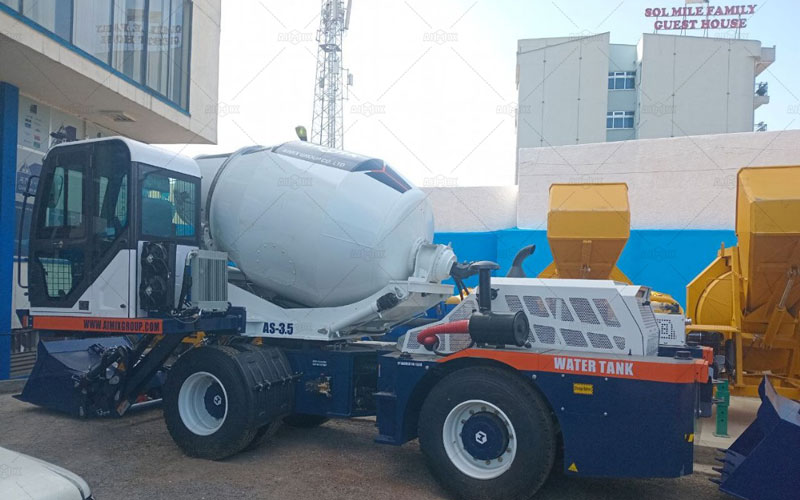
Material handling is an important consideration when investing in concrete production equipment in Ghana. From transporting sand and aggregates to supplying water and cement, every stage affects the time, labor, and resources required to produce concrete on-site. For contractors working on rural roads, residential developments, drainage systems, and small commercial projects, material supply conditions can influence equipment selection as much as mixing capacity. A self loading cement mixer combines material loading, weighing, mixing, and transportation within one machine, potentially simplifying operations where separate loading equipment and concrete delivery vehicles are difficult to coordinate. However, its investment value depends on site accessibility, aggregate storage, material consistency, and the distance between stockpiles and pouring locations.
1. How Material Handling Conditions Shape Concrete Production in Ghana
1.1 Aggregate Transportation and Stockpile Accessibility
Sand and crushed stone often need to be moved from delivery points or temporary stockpiles to the mixing area. On confined construction sites, uneven ground, narrow access routes, or poorly organized storage areas can increase the time required for each loading cycle. If the operator must repeatedly reposition the machine to collect aggregates, actual concrete output may fall below its theoretical capacity.
A self-loading mixer in Ghana can help reduce these handling steps because its integrated loading bucket collects aggregates directly. Contractors should nevertheless evaluate stockpile height, ground stability, turning space, and the distance between material storage and concrete placement. A machine that can approach stockpiles easily is more likely to maintain a consistent production rhythm.
1.2 Cement and Water Supply Coordination
Aggregates are only one part of the material supply chain. Cement must remain dry and accessible, while water needs to be available in sufficient quantities for the intended concrete mix. When workers carry cement bags over long distances or refill water manually between batches, production cycles can become irregular.
Before purchasing equipment, contractors should plan where cement will be stored, how water will be supplied, and how materials will reach the loading area. Better coordination can reduce unnecessary handling without requiring additional machinery for every task.
2. How Material Handling Challenges Influence Investment Costs
2.1 Labor Requirements and Equipment Utilization
Traditional concrete production may involve separate workers for aggregate loading, mixing, and transportation. A self-loading mixer consolidates several operations, potentially reducing dependence on separate loading equipment and simplifying crew coordination. This is particularly relevant to contractors managing multiple small projects or operating in locations where skilled labor is difficult to organize consistently.
However, labor savings should be calculated against actual working conditions. Operators still need training, routine maintenance, material preparation, and appropriate site supervision. The practical benefit comes from reducing duplicated tasks and idle time rather than assuming that one machine eliminates every manual operation.

2.2 Evaluating the Concrete Mixer Machine Price in Ghana
The purchase price is only one component of the total investment. Shipping, import duties where applicable, inland transportation, spare parts, operator training, fuel consumption, and maintenance all influence the final ownership cost. Difficult access to remote sites may also increase equipment delivery expenses and complicate future servicing.
When comparing the concrete mixer machine price in Ghana, buyers should request a complete quotation that identifies the machine configuration, included accessories, delivery arrangements, warranty terms, and after-sales support. A lower initial quotation may not represent a lower overall cost if essential components or support services are excluded.
Key Cost Factors to Assess Before Purchase
Material handling: The distance and effort required to collect aggregates, cement, and water.
Operating expenses: Fuel, routine servicing, wear parts, and labor.
Logistics: Shipping, customs-related charges, and transportation to the project site.
Utilization: Expected working hours, daily concrete demand, and the number of active projects.
Support: Spare-part availability, technical assistance, and operator training.
3. Matching Self-Loading Mixer Capacity to Site Conditions
3.1 Small and Medium-Sized Construction Projects
For residential foundations, small drainage channels, compound paving, and rural construction, concrete demand may fluctuate throughout the day. A self-loading mixer can be useful when the site requires repeated small batches and transporting ready-mixed concrete from a central plant is impractical.
Contractors searching for a mini concrete mixer for sale in Ghana should compare effective mixing capacity, bucket volume, maneuverability, discharge arrangements, and the machine’s ability to operate on the actual terrain. The nominal drum volume alone does not determine how much usable concrete can be delivered per hour.
3.2 Remote Sites and Changing Work Locations
Projects outside major urban centers may involve long material delivery routes, limited storage infrastructure, or frequent changes in working location. In these circumstances, a mobile machine can provide greater operational flexibility than a fixed mixing arrangement, provided that aggregates, cement, and water remain accessible.
Buyers should also assess road width, gradients, turning space, ground bearing conditions, and access for maintenance vehicles. These practical details influence whether the mixer can reach the work area efficiently and whether its mobility translates into productive operating hours.
4. Improving Material Handling Before the Mixer Arrives
4.1 Organize Stockpiles and Loading Routes
Designate separate storage areas for sand and different aggregate sizes. Keep loading routes clear, minimize unnecessary reversing, and position stockpiles within the machine’s practical working reach. Where possible, prepare a stable operating surface to reduce delays caused by soft ground or uneven access.
4.2 Standardize Batching and Material Quality
Consistent material proportions are essential for reliable concrete quality. Contractors should establish clear procedures for aggregate measurement, cement dosing, water addition, and moisture adjustments. Wet aggregates can change the effective water-cement ratio, so operators must account for material conditions rather than following a fixed water quantity without inspection.
Standardized procedures help make production more predictable and allow equipment performance to be evaluated using comparable batch records.

5. Calculate the Investment Return Using Real Project Data
A practical investment assessment should compare the self-loading mixer’s total ownership cost with the cost of the existing production method. Record average daily concrete demand, cycle time, labor hours, fuel consumption, equipment downtime, and the cost of transporting concrete or aggregates. These figures provide a more reliable basis for estimating savings than advertised maximum output.
For example, a contractor completing several small pours each day may benefit from reduced coordination between loading, mixing, and transportation. Conversely, a project requiring sustained high-volume concrete production may need a batching plant and dedicated delivery or pumping equipment. The appropriate configuration depends on production continuity, site layout, and the required placement rate.
Conclusion
Material handling challenges can substantially influence the productivity and financial performance of a self-loading mixer investment in Ghana. Aggregate accessibility, cement storage, water availability, labor organization, and site mobility all affect the machine’s practical output. By assessing these conditions before purchase, contractors can select an appropriate capacity, prepare efficient loading routes, and estimate ownership costs more accurately. The objective is not simply to acquire a mobile mixer, but to establish a dependable concrete production process that fits the project’s material supply conditions and construction schedule.
Comments
No comments yet. Be the first to react!