Concrete supply becomes more complicated when a construction site is located far from a ready-mix plant. This situation can affect contractors working on rural housing, roads, drainage systems, agricultural facilities, schools, and other infrastructure projects across Ghana. Fresh concrete must arrive at the site within an appropriate working period, while long transportation distances can introduce delays, scheduling difficulties, and additional logistics costs. For projects with irregular or moderate concrete demand, depending entirely on distant ready-mix deliveries may not always provide the most practical solution. The first step is not simply to choose a concrete machine. Contractors need to examine where the project is located, how much concrete is required, how frequently concrete will be used, and whether production demand changes during different construction stages. By comparing external supply with on-site production, contractors can develop a more flexible concrete plan that matches the realities of the project rather than relying on a single supply method.
Start by Understanding the Real Distance Between the Project and Concrete Supply
Long Delivery Routes Can Create More Than Transportation Costs
When a construction site is located far from a ready-mix supplier, transportation becomes an important part of the concrete production equation. The issue is not limited to the distance shown on a map. Road conditions, traffic, weather, vehicle availability, and loading schedules can all affect delivery time. A journey that appears manageable under normal conditions may become less predictable when construction takes place in remote areas or when access roads are difficult. Fresh concrete also requires careful timing. The construction crew, formwork, reinforcement, and placement equipment must be ready when the concrete arrives. If delivery is delayed, workers may remain idle. If the site is not prepared, the concrete truck may have to wait. This creates a chain of dependencies: Ready-mix plant → truck scheduling → transportation → site access → concrete placement. The longer this chain becomes, the more important logistics management can be.
Calculate Concrete Demand Before Selecting a Supply Method
Not every remote project needs a complete on-site concrete production system. The most suitable solution depends heavily on the quantity and frequency of concrete consumption. A large infrastructure project requiring continuous high-volume concrete may still benefit from a dedicated batching operation or carefully coordinated ready-mix supply. A smaller project with intermittent demand may require a different approach, like adopting a self loading cement mixer. Contractors should examine:

Average concrete consumption per day
Peak concrete demand during major pours
Total project duration
Frequency of concrete work
Distance from the nearest ready-mix supplier
Road and site accessibility
Availability of raw materials near the project
These factors provide a more realistic foundation for concrete production planning.
Choose a Flexible Production Method for Remote Construction Conditions
On-Site Production Can Reduce Dependence on Finished Concrete Delivery
One approach is to transport raw materials closer to the project and produce concrete at or near the construction site. This changes the supply model. Instead of depending on the delivery of freshly mixed concrete over a long distance, contractors can organize aggregate, cement, water, and other materials locally before producing concrete according to the construction schedule. On-site production can be particularly useful when concrete demand is irregular. For example, a contractor may need concrete for foundations during one phase, drainage structures during another phase, and slabs later in the project. Producing concrete according to actual demand can provide greater flexibility than arranging multiple small deliveries from a distant plant.
Consider Mobility When the Work Area Changes
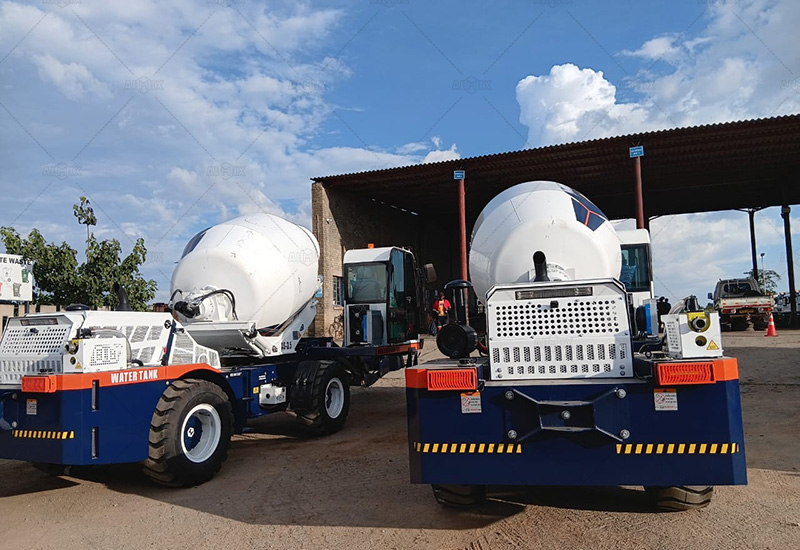
Many projects do not remain concentrated in one small location. Road construction, drainage works, rural infrastructure, and housing developments may progress across a wider area. In these situations, equipment mobility becomes an important consideration. A self loading concrete mixer for sale in Ghana can provide contractors with a more integrated production method by combining material loading, mixing, and transportation functions in one machine. Rather than producing concrete at a distant fixed location, the equipment can move around the project according to site requirements. This can be valuable when the active work front changes frequently.
Production Can Follow the Construction Schedule
The primary advantage of flexible equipment is not simply mobility. It is the ability to organize concrete production around actual site progress. A contractor can prepare one section of work, produce the required concrete, complete the placement operation, and then move to the next section. This approach may reduce the need to predict the entire project’s concrete demand far in advance.
Plan Equipment Investment Around Long-Term Project Needs
Buying Equipment Should Not Be Based Only on Machine Price
Contractors considering whether to buy concrete mixer in Ghana should evaluate the complete operating picture. The initial purchase cost is important, but it represents only one part of the decision. Fuel consumption, maintenance, labor requirements, production capacity, spare parts, and expected equipment utilization can all influence the long-term value of the investment. A machine that is suitable for one project may be underutilized after construction is completed. Therefore, contractors should consider whether the equipment can also support future projects. A mobile mixer used across multiple rural construction sites may provide greater utilization than equipment designed for a single permanent production location.
Match Mixer Capacity With the Contractor’s Typical Work
More capacity is not automatically better. A contractor specializing in small and medium-sized housing, agricultural, or drainage projects may not need the same concrete production capacity as a company supplying a major highway or industrial development. Oversized equipment can require additional investment and may create unnecessary operating costs. Undersized equipment, on the other hand, can slow construction progress during periods of high demand. The objective is to find a practical balance between production capacity and actual workload.

Look Beyond the Equipment Advertisement
The concrete mixer for sale in Ghana market includes different machine types and capacities. Contractors should compare equipment according to their actual project conditions rather than selecting a machine solely because of a high theoretical output. Important questions include:
How much concrete does the contractor usually produce?
How often does the equipment need to move?
What are the typical road and terrain conditions?
How many projects will use the machine each year?
Is on-site concrete production needed regularly or only occasionally?
These questions can help prevent an equipment purchase that does not match the contractor’s real business requirements.
Maintain Ready-Mix Supply as Part of a Flexible Strategy
On-site production does not mean ready-mix concrete should always be replaced. For large continuous pours, a commercial ready mix concrete batching plant and mixer truck fleet may remain highly efficient. Contractors can also use different supply methods for different stages of the same project. A flexible strategy may include ready-mix concrete for major pours and on-site mixing for smaller, remote, or irregular concrete requirements. This hybrid approach allows contractors to select the most appropriate method according to the specific construction activity.
Build Concrete Production Around Project Reality
For Ghana’s contractors, distance from a ready-mix supplier can significantly influence project planning. Long delivery routes may create scheduling uncertainty, increase transportation dependence, and make small or irregular concrete orders more difficult to manage. The solution begins with understanding the project’s actual concrete requirements. Contractors should assess demand, location, transportation conditions, and future equipment utilization before choosing a supply method. Where projects are remote or geographically dispersed, flexible on-site production can provide greater control. Mobile equipment can help bring concrete production closer to the work area, while appropriately sized mixers can allow production to follow the pace of construction. Ultimately, the most effective concrete supply strategy is not always the one with the largest plant or the highest-capacity machine. It is the one that delivers the required concrete at the right location, in the right quantity, and at the right time. For contractors working far from established ready-mix infrastructure, careful production planning can turn distance from a logistical obstacle into a manageable part of the construction process.
Comments
No comments yet. Be the first to react!