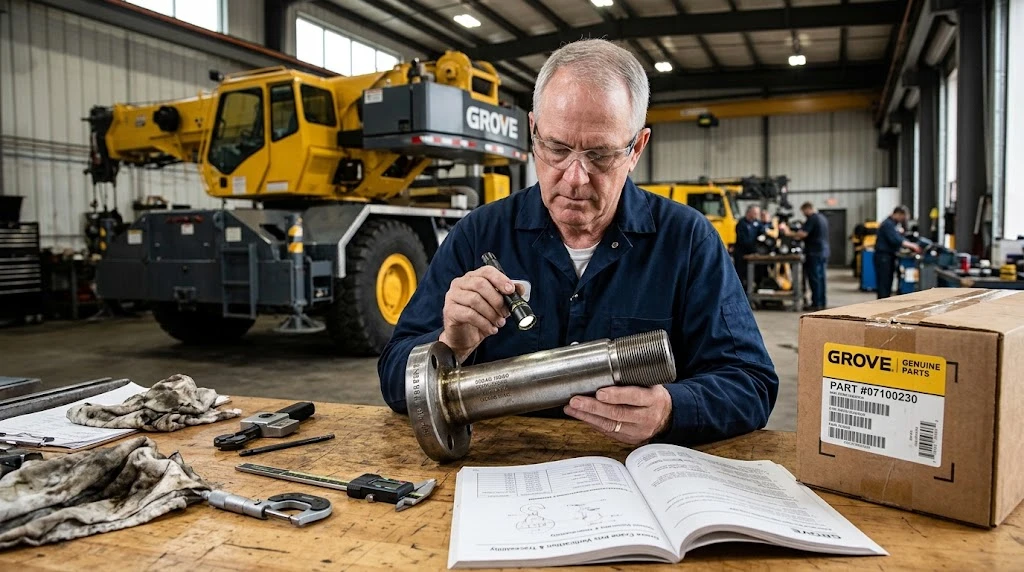
The connection between a crane and its replacement parts is built on an unspoken contract. That contract says the metal will perform as designed, absorb stress without failing, and keep operators and ground crews out of harm’s way. Violate that contract, and the consequences arrive without warning.
Three categories fill the shelves. Authentic pieces with full engineering pedigree. Aftermarket alternatives from makers who put their own name forward honestly. And counterfeit goods that masquerade as premium while hiding dangerous shortcuts. Distinguishing among them is a core competency for anyone who maintains lifting equipment.
Here is a systematic method for validating your Grove parts before they become part of your crane.
Packaging Is the First Witness
Counterfeiters frequently stumble on the wrapper. Legitimate producers treat packaging as a protective system, not an afterthought. They specify materials, coatings, and print standards that survive rough handling.
Pick up the box and assess it. Is the board thickness adequate? Do the graphics look like they were printed on a home inkjet? Genuine cartons are robust, with sharp registration and color accuracy. Fuzzy logos, misspelled words, or colors that drift from brand standards are immediate red flags.
Security features complete the picture. Holographic seals, tamper-evident tapes, and serialized barcodes are investments counterfeiters avoid. If these are missing, damaged, or look like they were applied as an afterthought, the contents require independent verification.
Let the Part Speak for Itself
Once unwrapped, the component enters the courtroom of your inspection. Authentic crane parts bear the hallmarks of precision manufacturing. Surfaces are uniform. Edges are deburred. There is a consistency that speaks to process control.
Counterfeit operations cannot replicate this. Tool marks from worn cutters may scar visible faces. Fastener holes may show ovality or tearing. Pins may have slight curvature. Threads may vary in pitch. Each defect is a vote against using the part.
Surface protection tells a parallel story. Genuine finishes are formulated for longevity in harsh environments. They adhere tenaciously and cover evenly. A finish that scratches away with minimal effort, or that pools in some areas and misses others, signals a knockoff. Paint inside threaded bores or on precision mating surfaces is another sign of careless production.
Decoding the Permanent Record
Cast and forged heavy components carry identifiers that outlast the part itself. These marks are the foundation of traceability.
Find the manufacturer symbol, the part designation, and the heat or batch code. These stamps create a link to the original material certification and production records. Counterfeit stamps are improving, but they still tend to show telltale flaws: shallow depth, uneven spacing, or characters that do not match the OEM’s standard die set.
Authentic impressions are forceful and precise. They are made with hardened dies under controlled conditions. Light, wandering, or chemically etched marks are the signatures of fraud.
Density and Hardness as Diagnostics
Steel has a weight that becomes familiar. Technicians who handle crane components daily develop a calibrated sense of normal. Counterfeiters exploit this by substituting lighter, weaker materials.
Weigh the replacement against the original. A meaningful discrepancy suggests material fraud. The alloys in authentic Grove parts are selected for specific yield strength, fatigue life, and impact resistance. Substitute metals will not deliver equivalent performance.
A file test resolves lingering doubts. Apply a standard file to an inconspicuous area. If it bites deeply into what should be hardened alloy steel, the quench and temper cycle was omitted or botched. That component has no business on a crane.
The Documentation Chain
Genuine parts travel with a paper identity. Packing list. Commercial invoice. And frequently a Certificate of Conformance that attests to specification compliance.
That certificate is actionable. It lists the part number, the batch identifier, and the date of manufacture. Verify it. Contact the supplier or the manufacturer and request confirmation that the batch exists and matches the part. Reputable organizations maintain these records and will validate them.
Consistency between packaging and part is equally critical. Some schemes place authentic numbers on counterfeit boxes. The part inside may carry a different number, or none at all. That disconnect is proof of deception.
Aftermarket Clarity
This distinction protects honest commerce. Aftermarket parts are legitimate products. They are manufactured by independent companies, marketed under their own trademarks, and engineered to fit and function correctly. Many produce excellent crane parts that compete well with OEM offerings.
Counterfeits are theft. They appropriate branding, forge packaging, and claim a manufacturing heritage they never possessed. They bypass certification, ignore safety margins, and endanger everyone in the lift radius. Pricing that seems unrealistically attractive, or parts that lack standard traceability, should be presumed counterfeit until verified.
Source Verification
Your supplier is your first filter. Authorized distributors maintain direct, documented relationships with manufacturers. Their authenticity is structurally assured.
Independent sellers and online platforms require diligence. Interrogate them. Request sourcing details. Demand batch codes before purchase. Transparency builds trust. Deflection or irritation destroys it.
Accountable suppliers support their products. They furnish documentation, provide technical guidance, and honor warranty obligations. A seller who claims OEM status while refusing returns or warranty coverage is advertising their own dishonesty.
Beyond Visual Inspection
Some components carry too much risk for surface examination alone. Used hook blocks. Boom pins from decommissioned units. Swivels with undocumented service hours. These may be genuine but compromised.
Non-destructive testing provides certainty. Magnetic particle inspection detects surface cracks. Liquid penetrant testing serves non-ferrous materials. Radiographic examination reveals internal defects like shrinkage voids or sand inclusions. These methods identify damage from prior overloads or manufacturing errors before catastrophic failure occurs.
The Weight of Experience
Intuition is not magic. It is the accumulation of observed patterns over years of practice. Packaging that feels insubstantial. A finish that looks hurried. A price that makes you pause. These patterns form a protective radar.
Cost pressure is real and persistent. But a failed crane component generates costs that render any initial savings meaningless—operational downtime, emergency repairs, regulatory penalties, and human injury. Verification is the most cost-effective maintenance you can perform.
Institutionalize the authentication of your Grove parts. Examine the packaging. Evaluate the metal. Insist on documentation. Build supplier relationships on verified trust. When the operator engages the hoist and the load rises, your confidence in every component must be complete. That confidence is built through disciplined, repeatable verification processes applied without exception.
Comments
No comments yet. Be the first to react!