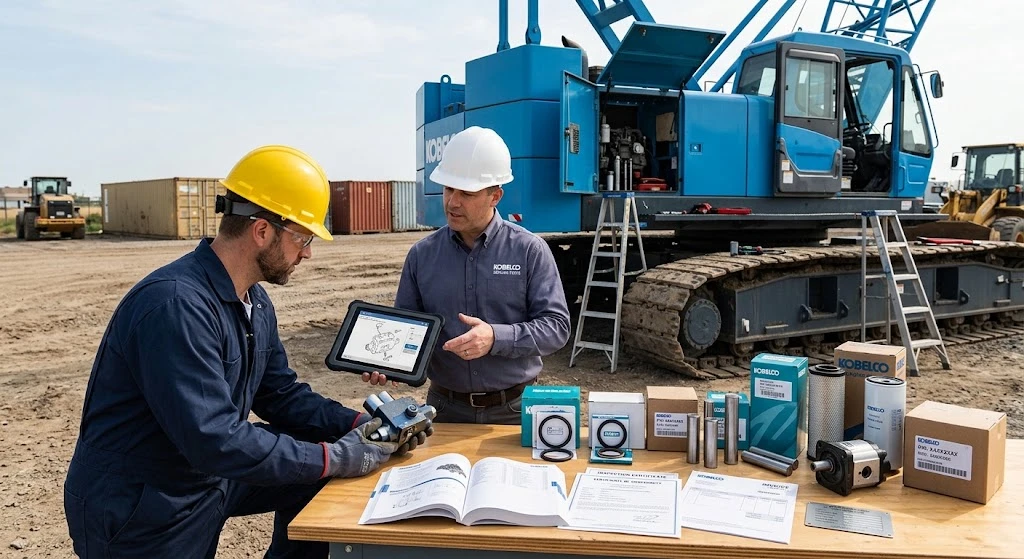
Downtime doesn’t negotiate. When a Kobelco crane sits motionless on a jobsite, the financial damage compounds with every passing hour. Whether you’re dealing with a sluggish swing motor on a CKE unit or blown boom cylinder seals on a rough-terrain machine, the urgency is identical.
Your instinct is to move fast. Locate the part number, pull up a search engine, find a listing with a competitive price, and click through. It feels efficient. It feels like progress.
But Kobelco parts demand more care than a quick online transaction allows. These machines carry tight tolerances and model-year-specific configurations that general-market parts don’t always account for. Installing the wrong component—or one that seems compatible but violates an engineering specification—can create a cascade of secondary failures costing far more than the original purchase.
I’ve personally seen a $400 valve trigger $6,000 in lost productive time because someone skipped a basic verification call. Before entering payment information, run through these five questions. They take minutes to ask and can prevent expensive lessons.
1. “Is this part OEM, or aftermarket? And if aftermarket, who actually made it?”
There’s nothing wrong with choosing aftermarket. Plenty of operators do, and for good reason. Quality aftermarket Kobelco parts frequently deliver dependable performance at a noticeably lower cost than their factory equivalents. The key word, though, is “quality.”
If the seller uses phrases like “OEM equivalent” or “direct replacement,” press for detail. What company manufactured it? What brand name does it carry? Was it engineered from Kobelco’s original specifications, or reverse-engineered from a used sample?
For high-stress applications—wire ropes, boom pins, swing bearings, main hydraulic pumps—OEM or a recognized aftermarket brand is the safer route. Seals, filters, and wear plates? A reputable aftermarket producer handles those well. The underlying principle is straightforward: informed choices require complete information. Any crane parts supplier worth working with will furnish that information upfront without deflection.
2. “Can you cross-reference this part number against my exact model and serial number?”
Kobelco’s crane lineup is extensive, and model designations alone don’t tell the full story. The CK, CKE, RK, and SL families each contain multiple production revisions with internal differences that are invisible from the outside. Components from a 2014 CKE2500G won’t necessarily bolt onto a 2019 CKE2500G-2 without modification.
Supply the seller with your full model code, serial number, and year of manufacture. A competent crane parts supplier will consult their catalog and cross-check every detail before confirming compatibility. A less thorough operation will simply echo back the number you provided and ship without verification.
Inability or unwillingness to verify fitment against your serial number should concern you. You need access to Kobelco’s parts breakdowns, not a generic search interface. This requirement intensifies for hydraulic and electrical assemblies. A solenoid valve that physically resembles yours might operate at a different voltage or feature a revised port layout between production years.
3. “What’s the actual lead time, and is this part physically in your warehouse right now?”
The phrase “in stock” is elastic. For some sellers, it confirms the part rests on a shelf within their facility. For others, it merely indicates they can order it from a third-party distributor within a fortnight and classify that as “available.”
Be direct: “Is this item on your shelf, or are you sourcing it externally?” If it’s being sourced, from where? A domestic distribution center or an overseas facility? What’s the honest delivery window to your location?
If your crane is down and contract penalties are accumulating daily, you require certainty. Not “typically ships within three to five business days.” You need “it’s sitting in our Jacksonville warehouse and departs today if you place the order by noon.”
Also address freight logistics upfront. Certain Kobelco parts—boom sections, counterweights, complete hydraulic assemblies—are bulky and heavy. Shipping method matters enormously. A supplier capable of arranging same-day freight or guaranteed expedited delivery proves invaluable when time pressure is at its peak.
4. “What’s the warranty, and what does the return process actually look like?”
Promises to “stand behind our products” are universal among crane parts suppliers. Follow-through details, however, are less commonly volunteered.
Demand specifics in writing or via email. What’s the duration of coverage? Does it extend to premature wear under normal operating conditions, or only to manufacturing defects? If a return becomes necessary, who pays the outbound shipping—do they supply a prepaid label, or is that your expense?
For aftermarket components, ask explicitly about fitment guarantees. If the part arrives incompatible despite the seller having confirmed the part number, who absorbs return freight and any restocking charges? You don’t want to discover those answers only after a $2,000 pump lands at your yard with the wrong mounting flange.
5. “Can you provide documentation—test certificates, material specs, or traceability records?”
This final question draws a clear line between professional operations and casual resellers.
For safety-critical or load-bearing Kobelco parts—wire ropes, hooks, sheaves, structural pins, hydraulic cylinders—supporting documentation is essential. Material test reports, load test certificates, proof of conformance to relevant ISO or JIS standards. These aren’t bureaucratic niceties; they’re operational necessities.
In regulated industries or on sites with strict compliance requirements, traceability paperwork is non-negotiable. You need that chain of custody. Even for less critical items, a seller who can produce a datasheet or material specification demonstrates real product familiarity. They understand what they’re distributing beyond its catalog listing.
Ask plainly: “Will you include the certification or spec sheet with my shipment?” Note any hesitation or promises to “check with the manufacturer.” That response reveals the depth—or lack thereof—of their inventory expertise.
The Bigger Picture
Consider these questions a standard part of your procurement process, not an adversarial exercise. You’re conducting reasonable due diligence, nothing more—similar to inspecting rigging hardware before a lift.
A trustworthy seller welcomes these inquiries rather than resenting them. They recognize that informed buyers build long-term professional relationships. When you call at dawn next month with a failed hose assembly and concrete curing on schedule, that established rapport means your call gets answered immediately.
Conversely, vendors who deflect questions, offer vague generalities, or push urgency with phrases like “just place the order”—those relationships tend to produce exactly the kind of problems these questions prevent. Your Kobelco has earned its reputation on jobsites everywhere. It deserves replacement components that meet original specifications, perform under pressure, and come with someone accountable standing behind the transaction. Five targeted questions. A brief phone call. That margin of effort separates a reliable repair from a recurring headache.
Comments
No comments yet. Be the first to react!