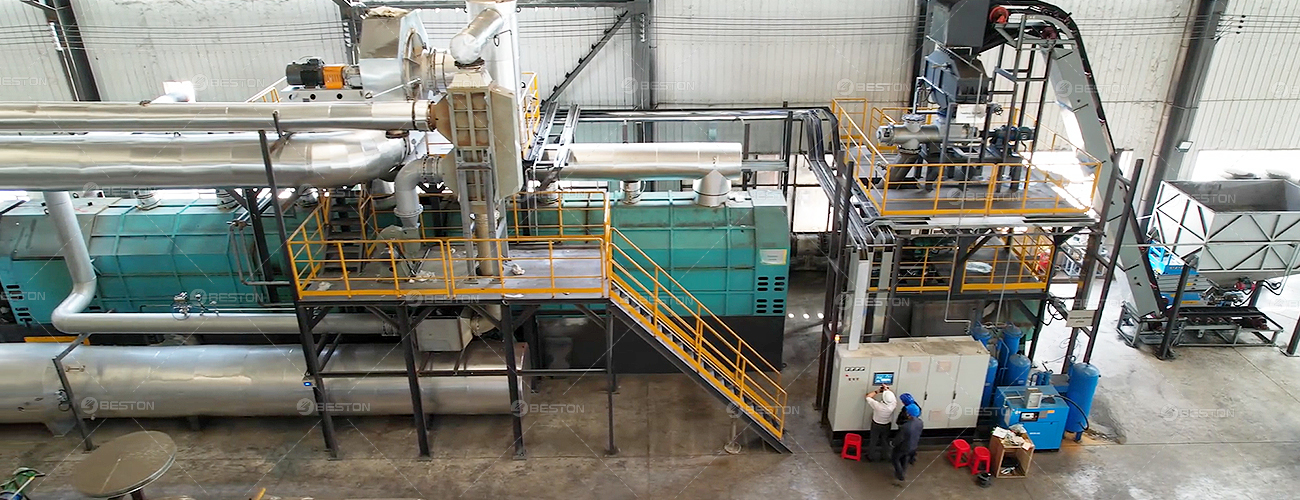
The evolution of industrial pyrolysis is increasingly defined by something beyond reactor design: digital process intelligence. Modern continuous pyrolysis equipment is no longer operated solely through manual inspection and fixed operating parameters. Instead, sensors, automated control systems, data acquisition platforms, and predictive algorithms are being integrated into the process architecture. This shift is making pyrolysis operation more measurable, responsive, and repeatable.
Real-Time Monitoring Improves Process Visibility
Continuous pyrolysis depends on maintaining stable thermal conditions as feedstock moves through the reactor. Variations in moisture, particle size, feed rate, or composition can alter heat demand and product distribution. Conventional monitoring methods may detect these deviations only after they have affected production.
Digital monitoring changes this dynamic.
Temperature sensors can track conditions at multiple points within the reactor, while pressure transmitters, flow meters, gas analyzers, and level sensors provide additional process information. Operators can therefore observe the thermal profile and material movement continuously rather than relying on periodic manual checks.
This creates a more granular operational picture. Small deviations can be identified before they develop into significant process disturbances.
Automated Control Stabilizes Reactor Performance
Process control is particularly valuable for continuous pyrolysis equipment because the system must operate for extended periods with minimal interruption. Automated controllers can adjust heating intensity, feed rate, gas circulation, and other parameters according to real-time measurements.
For example, if reactor temperature begins to fall below its operating range, the control system can increase heat input within predefined limits. If pressure starts to fluctuate, the system can respond by modifying gas-handling parameters or triggering an alarm.
This closed-loop approach reduces dependence on manual intervention. More importantly, it helps maintain a consistent reaction environment, which can support more stable yields of pyrolysis oil, combustible gas, and char.
Data Analytics Supports Predictive Maintenance
Digitalization also changes how equipment maintenance is managed. Instead of relying exclusively on fixed maintenance schedules, operators can use historical and real-time data to identify abnormal operating patterns.
Bearing temperature, motor load, vibration, pressure fluctuations, and energy consumption can act as operational indicators. A gradual increase in motor current, for instance, may signal mechanical resistance or material accumulation. Detecting such a trend early allows maintenance personnel to investigate the issue before it develops into an unplanned shutdown.
Predictive maintenance is especially consequential for continuous systems because unexpected downtime can interrupt feedstock handling, heating, condensation, and product collection simultaneously.
Energy Optimization Becomes More Precise
Energy consumption is another area where digital process control can provide measurable benefits. Pyrolysis requires carefully regulated heat, and excessive heating can waste energy while insufficient heating may compromise thermal decomposition.
A digitally controlled system can correlate reactor temperature, feedstock throughput, gas production, and fuel consumption. These datasets allow operators to identify inefficient operating zones and refine heating strategies.
Advanced systems may also use process data to optimize internal gas circulation and recover usable thermal energy from combustible pyrolysis gas. The objective is not simply to maximize heat input, but to achieve the required thermal environment with less unnecessary energy expenditure.
Digital Records Improve Traceability and Decision-Making
Continuous pyrolysis equipment can generate substantial quantities of operational data. When these records are systematically collected, they become useful for production analysis, quality management, and troubleshooting.
Operators can compare different feedstock batches, identify relationships between operating parameters and product output, and establish historical performance benchmarks. This creates a form of operational traceability that is difficult to achieve with manual records alone.
Remote dashboards can further allow authorized personnel to review key parameters without remaining beside the equipment throughout the operating cycle.
The Next Stage: Smarter and More Autonomous Operation
The trajectory of pyrolysis technology is moving toward increasingly interconnected systems. Industrial Internet of Things architecture, edge computing, machine learning, and digital twins could enable more sophisticated optimization of reactor performance.
The fundamental principle remains straightforward: measure more, respond faster, and control more precisely.
As digital monitoring becomes embedded within continuous pyrolysis equipment, operation is shifting from reactive management toward predictive and data-driven control. The result is a more intelligible industrial process, where thermal behavior, equipment condition, energy consumption, and production performance can be evaluated as interconnected variables rather than isolated parameters.

Comments
No comments yet. Be the first to react!