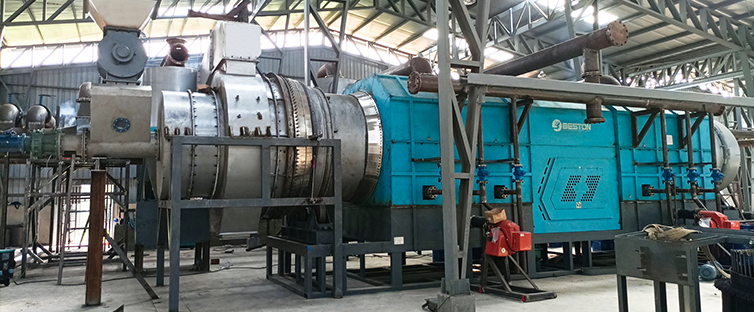
Straw is a heterogeneous lignocellulosic feedstock with distinctive thermal behavior during pyrolysis. Its composition, ash content, moisture, particle size, and mineral fraction all influence how it decomposes under oxygen-limited conditions. These characteristics determine heat demand, volatile release, biochar yield, and the properties of the resulting product.
For agricultural residue processing, understanding the thermal response of straw is essential for selecting operating conditions and designing a stable pyrolysis system.
Lignocellulosic Structure Controls Thermal Decomposition
Straw mainly contains cellulose, hemicellulose, and lignin. These three structural components decompose across different temperature ranges rather than breaking down simultaneously.
Hemicellulose generally begins decomposing at a lower temperature. Cellulose undergoes a more pronounced devolatilization stage at higher temperatures. Lignin decomposes over a broader temperature interval and contributes significantly to the formation of fixed carbon and aromatic structures.
This staggered decomposition creates a characteristic mass-loss profile during heating. The relative proportion of each component varies among wheat straw, rice straw, corn stalk, barley straw, and other agricultural residues. As a result, two straw feedstocks can exhibit different pyrolysis behavior even when processed under similar conditions in straw charcoal machine.

Moisture Influences Heat Transfer and Energy Demand
Fresh straw can contain considerable moisture. Before pyrolysis, part of the supplied thermal energy is consumed to evaporate this water.
High moisture therefore increases the specific heat requirement and can reduce the effective thermal efficiency of the system. It can also influence reactor temperature stability because evaporation absorbs heat during the early stage of processing.
Drying is consequently an important part of straw pyrolysis. The target moisture level depends on the biochar reactor configuration, feedstock handling system, and available heat source.
Waste heat from the pyrolysis process can potentially be recovered for drying. This creates an internal heat-integration pathway and reduces the amount of external energy required for feedstock preparation.
Ash and Mineral Content Affect Pyrolysis Behavior
Straw generally contains more mineral matter than clean woody biomass. The ash fraction can include silica, potassium, calcium, magnesium, and other inorganic components.
Rice straw is particularly notable for its relatively high silica content. These minerals remain largely in the solid fraction after pyrolysis and can significantly affect biochar ash content.
Mineral matter can also influence secondary reactions during thermal conversion. Alkali and alkaline-earth metals may catalyze certain reactions involving volatile compounds and carbon structures.
For this reason, ash content should be considered when evaluating straw biochar for a specific application. A high fixed-carbon value alone does not fully describe product quality.
Particle Size Affects Heating and Residence Time
Straw has a fibrous structure and relatively low bulk density. These physical characteristics can complicate feeding and heat transfer.
Large or irregular particles require more time for heat to penetrate toward the center. Smaller particles generally provide a shorter internal heat-transfer path and more uniform thermal exposure.
However, excessive grinding increases electricity consumption and may create dust-handling challenges. The appropriate particle size is therefore a balance between feeding stability, heat-transfer efficiency, pretreatment cost, and reactor design.
A stable feed system is particularly important for continuous pyrolysis because fluctuations in feed rate can cause corresponding changes in reactor temperature and product yield.
Volatile Release Determines Product Distribution
As straw is heated, its organic structure progressively breaks down into solid, liquid, and gaseous products.
At lower temperatures, dehydration and initial devolatilization dominate. As temperature increases, cellulose and hemicellulose undergo more intensive decomposition. Organic vapors are released and can subsequently condense into liquid products or undergo secondary cracking.
Higher temperatures and longer vapor residence times generally promote further conversion of volatile compounds into permanent gases and secondary char-forming structures. The exact product distribution depends on heating rate, reactor configuration, vapor residence time, and temperature.
This means that pyrolysis temperature should not be evaluated independently. The entire thermal regime determines how straw is transformed.
Temperature Shapes Straw Biochar Properties
Temperature is one of the most important variables governing the final biochar structure.
At relatively moderate temperatures, more volatile matter and oxygen-containing functional groups can remain in the solid. Higher temperatures generally increase carbonization and aromaticity while reducing volatile matter and hydrogen-to-carbon ratios.
Higher-temperature biochar may therefore provide greater structural stability. However, excessive thermal severity can also increase gas production and reduce solid yield.
The optimal operating window depends on the intended application. Soil amendment, adsorbent production, construction material, and carbon removal projects can have different product specifications.
Process Design Should Match Feedstock Characteristics
Straw pyrolysis requires more than a suitable reactor temperature. Feedstock moisture, ash content, particle size, bulk density, and chemical composition should be evaluated before equipment selection.
| Straw Characteristic | Pyrolysis Implication | Process Response |
|---|---|---|
| High moisture | Greater drying energy demand | Integrate feedstock drying |
| High ash | Higher mineral content in biochar | Evaluate ash and contaminant profile |
| Fibrous structure | Feeding and heat-transfer challenges | Control particle size and feeding |
| Low bulk density | Large storage and conveying volume | Optimize material handling |
| High volatile content | Significant vapor release | Size condensation and gas systems |
A controlled thermal environment is also necessary to prevent unwanted oxidation. Reactor sealing, temperature measurement, heat distribution, and vapor management all contribute to stable operation.
From Agricultural Residue to Controlled Thermal Conversion
The pyrolysis characteristics of straw are determined by the interaction between its chemical composition and operating conditions. Cellulose, hemicellulose, and lignin govern the principal decomposition stages. Moisture affects energy demand. Minerals influence ash behavior and secondary reactions. Particle size controls heat transfer.
These factors should be considered together when designing a straw pyrolysis process. A feedstock-specific approach can improve thermal stability, product consistency, and energy efficiency while allowing the resulting biochar and other products to be matched with their intended applications.
Comments
No comments yet. Be the first to react!