Oil sludge represents one of the more recalcitrant waste streams generated by petroleum extraction, refining, and storage operations. Accumulated in tank bottoms, drilling sites, and wastewater treatment systems, this material contains a heterogeneous mixture of hydrocarbons, water, mineral solids, and potentially hazardous contaminants. Conventional disposal pathways such as landfilling and incineration face increasing regulatory restriction, prompting greater interest in thermochemical recovery technologies.
Among available treatment approaches, pyrolysis has attracted considerable attention due to its capacity to recover hydrocarbons while reducing waste volume. However, the industrial implementation of oil sludge pyrolysis remains technically demanding. The challenge extends beyond simple thermal decomposition and involves a complex interplay of material variability, heat transfer, corrosion, and environmental management.
The viability of oil sludge treatment therefore depends on overcoming several deeply interconnected engineering constraints.
Feedstock Heterogeneity as a Fundamental Challenge
Unstable Material Composition
Unlike standardized biomass or plastic feedstock, oil sludge exhibits pronounced compositional variability.
The material may contain:
- Heavy hydrocarbons
- Water
- Sand and mineral solids
- Heavy metals
- Salts
- Chemical additives
- Organic contaminants
This heterogeneity complicates process design because pyrolysis reactor performance depends heavily on feedstock consistency.
Two sludge batches originating from different facilities may behave in entirely different ways under identical thermal conditions. Variations in viscosity, oil content, and moisture level influence heating behavior and product distribution.
Consequently, feedstock unpredictability becomes one of the earliest technical barriers.
Pretreatment Requirements
Many oil sludge streams require pretreatment before entering a thermal reactor.
Pretreatment commonly includes:
- Screening
- Dewatering
- Homogenization
- Solid separation
- Size reduction
High moisture content presents a particular obstacle. Excess water consumes substantial thermal energy and lowers overall process efficiency.
Without adequate conditioning, unstable feeding and poor reactor performance may occur.
Heat Transfer and Reactor Stability
Thermal Conductivity Limitations
Oil sludge possesses poor and inconsistent thermal conductivity.
The coexistence of water, solids, and viscous hydrocarbons creates uneven heating behavior during thermal decomposition. Certain regions may experience overheating while others remain insufficiently processed.
This nonuniformity creates several operational complications:
- Incomplete pyrolysis
- Excess residue formation
- Secondary cracking
- Reduced oil recovery
- Temperature instability
Achieving homogeneous heat distribution is therefore considerably more difficult than in dry and free-flowing feedstock systems.
Reactor Fouling and Agglomeration
As temperature increases, sludge may become adhesive and form deposits on reactor walls and internal components.
Agglomeration can produce:
- Material bridging
- Reduced mixing efficiency
- Heat-transfer deterioration
- Mechanical obstruction
- Unplanned shutdowns
This fouling tendency is particularly problematic in poorly agitated or inadequately designed systems.
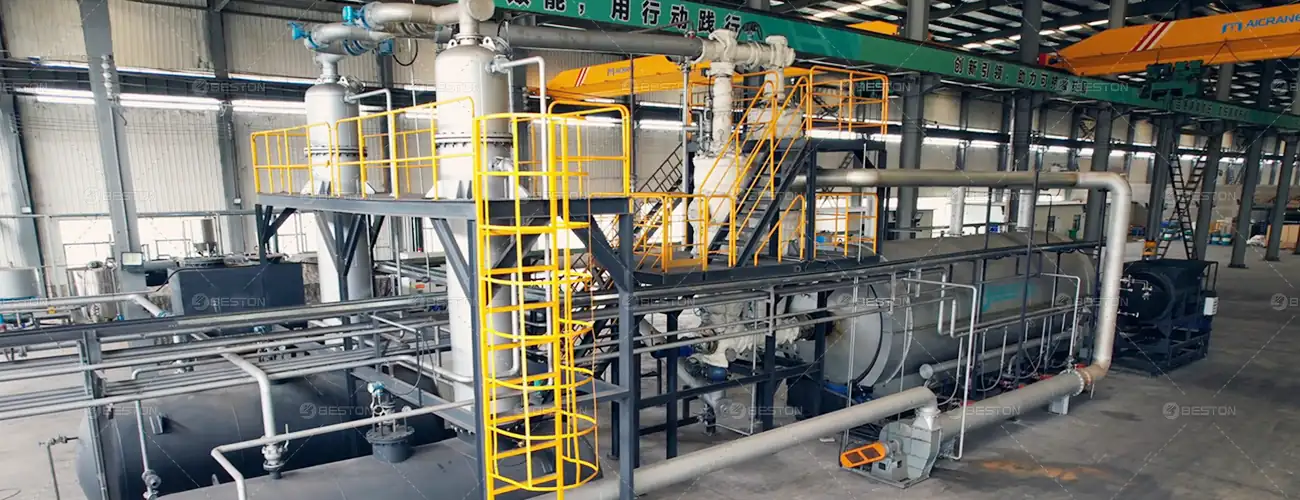
A modern oil sludge pyrolysis plant intended for oil sludge treatment generally incorporates specialized feeding mechanisms and robust reactor configurations capable of handling viscous and abrasive material. Even so, fouling remains a persistent maintenance concern.
Corrosion and Material Degradation
Salt and Sulfur Complications
Oil sludge frequently contains elevated concentrations of corrosive constituents.
Chlorides, sulfur compounds, and acidic substances may become increasingly aggressive under pyrolysis conditions. During thermal treatment, these elements can generate corrosive gas species capable of attacking metal surfaces.
Corrosion affects:
- Reactor shell integrity
- Condensation equipment
- Gas pipelines
- Heat exchangers
- Flue gas treatment systems
Accelerated material degradation not only increases maintenance expenditure but may also compromise process safety.
Selecting corrosion-resistant metallurgy therefore becomes a major engineering decision rather than a secondary design detail.
High Maintenance Burden
Because of abrasive mineral content and corrosive chemistry, oil sludge systems often experience higher wear rates than conventional thermal processing facilities.
Erosion and scaling may shorten equipment service life and increase spare-part consumption.
Operational reliability consequently depends on rigorous inspection protocols and preventative maintenance planning.
Product Quality and Recovery Difficulty
One of the principal motivations for oil sludge pyrolysis is hydrocarbon recovery. However, product quality presents its own technical complications.
Recovered oil may contain:
- Sulfur compounds
- Water traces
- Fine particulates
- Heavy hydrocarbon fractions
- Metallic contaminants
This composition can limit direct market usability.
Additional upgrading or purification may therefore be necessary before recovered oil can serve as industrial fuel or feedstock.
Gas composition also varies significantly depending on sludge characteristics and operating temperature. This variability complicates energy recovery and burner optimization.
Residual solid material introduces another challenge. Mineral-rich char or ash may retain heavy metals and require careful characterization before disposal or reuse.
Product recovery is therefore inseparable from downstream treatment strategy.
Environmental Control Requirements
Oil sludge pyrolysis operates under strict environmental expectations due to the hazardous nature of the feedstock.
Authorities commonly scrutinize:
- Atmospheric emission
- Odor generation
- Wastewater handling
- Residual toxicity
- Fugitive hydrocarbon release
Thermal decomposition may generate volatile organic compound and sulfur-bearing gas if process conditions are poorly controlled.
Accordingly, emission treatment systems often include:
- Condensation stages
- Dust filtration
- Gas scrubbing
- Thermal oxidation
- Continuous monitoring
Environmental compliance therefore requires a multilayered control framework rather than isolated treatment equipment.
Failure to manage secondary pollution can undermine the environmental rationale for the project itself.
Process Automation and Operational Complexity
Oil sludge pyrolysis demands tighter process control than many other thermochemical applications.
Operators must continuously manage:
- Reactor temperature
- Feed rate
- Pressure conditions
- Gas composition
- Moisture variation
- Condensation efficiency
Manual operation alone rarely provides sufficient precision.
A sophisticated pyrolysis plant increasingly relies on automation and digital monitoring to maintain process stability and reduce operational risk. Real-time diagnostics allow operators to respond to feedstock fluctuation before instability propagates throughout the system.
Automation thus functions not merely as a productivity enhancement but as a prerequisite for reliable operation.
Advancing Oil Sludge Pyrolysis Through Engineering Precision
Oil sludge pyrolysis presents compelling environmental and resource-recovery potential, yet the pathway to industrial success remains technically intricate. Material heterogeneity, thermal instability, corrosion, fouling, and environmental control collectively create a demanding engineering landscape.
The technology cannot be reduced to a simple heating process. Instead, successful deployment requires an integrated approach encompassing pretreatment, reactor design, metallurgy, emission governance, and automation.
Projects that recognize and address these technical barriers through rigorous engineering are more likely to transform oil sludge from a problematic waste stream into a recoverable industrial resource.
Comments
No comments yet. Be the first to react!