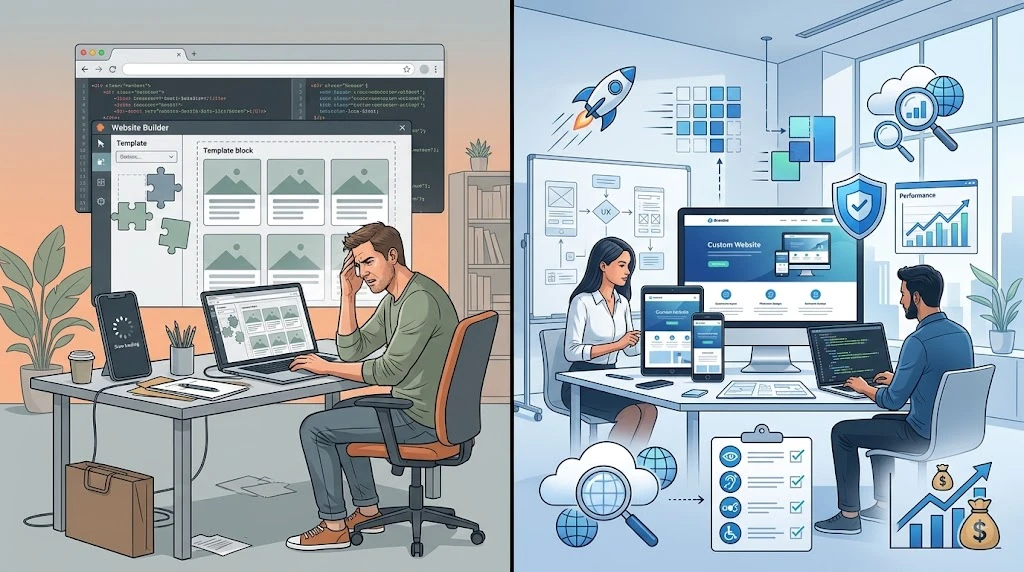
Artificial intelligence has introduced a new way to build websites. Platforms like Wix ADI, Framer AI, and Hostinger let users generate complete sites by answering a few questions. No coding. No design experience. Just a prompt and a few minutes. The appeal is obvious.
Entrepreneurs and small business owners often lack both time and budget for lengthy development cycles. An AI tool promises to bridge that gap almost instantly.
The question worth asking, though, is whether speed produces results that actually matter. A generated presence and a strategic digital asset serve fundamentally different purposes. Understanding that distinction determines which approach fits your situation.
What AI Gets Right
Fairness demands acknowledging the genuine strengths of automated builders. They are remarkably fast. They require almost no technical knowledge. And they cost a fraction of what professional development once demanded.
For side projects, early prototypes, or experimental ventures, the math works. You receive a presentable, mobile-friendly site without investing significant time or money. That accessibility has genuinely democratized getting online.
The challenge is that accessibility and effectiveness are separate conversations. AI tools handle the first one well. The second requires considerably more depth.
The Uniformity Problem
Machine learning generates output by analyzing patterns across enormous datasets. Show it a plumbing business, and it matches that business against the most common plumbing site templates in its training data.
This means your finished product shares structural DNA with dozens of similar businesses. Your competitor receives an almost identical result when they make the same request.
Visitors form judgments within seconds. They need to understand immediately what sets your business apart. When the surrounding design language feels interchangeable, that message gets lost. Templated copy and irrelevant stock imagery compound the problem.
Collaborating with a web design company introduces a fundamentally different process. Rather than pattern-matching against industry averages, professionals investigate your specific market position. They examine how you describe your value and translate that into visual and structural decisions unique to your brand.
Design Is More Than Decoration
A website that looks attractive but confuses visitors accomplishes nothing. Effective design marries aesthetics with intentional function at every level.
AI platforms handle surface-level conventions adequately. They position headers, footers, and buttons where statistical analysis suggests they should go. But recognizing placement conventions and understanding human motivation represent entirely different challenges.
Thoughtful designers map the complete visitor arc. They consider what someone thinks when they arrive, what concerns might arise along the way, and what final action feels natural. Crafting that progression demands genuine understanding of how people make decisions online.
Every audience carries different expectations and behaviors. A visitor evaluating enterprise software approaches a site with different priorities than someone comparing local restaurants. A skilled website designer adapts the experience accordingly, building navigation and content flows that resonate with each specific audience rather than applying universal templates.
Beyond Aesthetics: The Strategic Layer
A website exists to accomplish business objectives — generating leads, supporting conversions, establishing credibility. Reducing it to a visual project ignores its most important function.
When you engage a web design company for a project, the relationship starts with discovery conversations. What does your target customer look like? How do you differ from alternatives they are considering? What single outcome should every page drive toward?
Those answers influence content hierarchy, feature prioritization, and structural decisions that no automated system would make independently. Strategy transforms scattered pages into coordinated tools.
AI builders skip discovery entirely. They gather your industry label and company name, then apply the most statistically relevant template. No interrogation of goals or competitive positioning occurs.
Without that strategic foundation, a website becomes an uncoordinated collection of pages. Each may appear acceptable in isolation, but collectively they fail to guide anyone toward a meaningful business result.
Closed Systems Create Real Limitations
AI platforms excel within predefined boundaries. Their feature sets cover common requirements, and the user experience stays intentionally simple. That simplicity, however, becomes a constraint the moment needs evolve.
What occurs when your operations require a specialized CRM connection? Or a configurator that no pre-built module supports? Or a purchasing flow designed around your specific fulfillment process?
The answer is friction. The platform cannot accommodate the requirement, and the underlying architecture prevents creative workarounds.
Most AI builders position customization as a premium feature with narrow scope. Meaningful modifications demand expensive tier upgrades, and even then, fundamental restrictions persist because the architecture was never designed for flexibility.
A human developer approaches the challenge from the opposite direction. Code is written to match your requirements precisely. Custom API integrations, unique database logic, and purpose-built interfaces all become achievable when someone with deep technical skill architects the solution specifically for you.
This adaptability grows more critical as organizations scale. What works for a startup inevitably becomes inadequate as complexity increases.
Performance, Code Quality, and Search Rankings
Most website owners never examine the underlying code of their pages. Search engine algorithms, however, evaluate it constantly. Code quality directly influences how prominently your content appears in search results.
AI-generated websites frequently carry unnecessary weight. Redundant scripts power interactive editing features that end users never touch, yet they load on every single page. The cumulative impact is measurably degraded speed.
Loading performance affects both rankings and user satisfaction simultaneously. Studies consistently demonstrate that visitors abandon pages exceeding three seconds to load. Each additional second compounds abandonment rates and damages engagement metrics.
Hand-crafted code eliminates that inefficiency. Every element earns its place, and nothing loads without purpose. A website designer with strong technical fundamentals optimizes imagery, compresses assets, and organizes page structure for maximum efficiency as standard practice.
Technical search optimization extends well beyond raw speed. Proper heading hierarchies, structured data markup, and crawl-friendly architecture require expertise that surface-level tools cannot replicate. Intentional site organization — directing link equity toward priority pages — demands human understanding of competitive search landscapes. Rigid AI-generated code structures frequently struggle with the multi-layered hierarchies that aggressive search positioning requires.
Accessibility and the Trust Equation
Digital accessibility is both a legal mandate in numerous regions and an ethical obligation every organization should honor. Every visitor deserves usable access regardless of physical ability.
AI accessibility features have matured but remain unreliable when tested against real conditions. Auto-generated alternative text frequently misrepresents image content. Color combinations sometimes violate contrast thresholds without triggering system alerts. Keyboard navigation and screen reader compatibility demand human verification that automation cannot yet provide.
Human evaluators test without traditional input devices, verify compliance with established international standards, and catch nuances that algorithms consistently overlook. This diligence reduces legal exposure while meaningfully broadening reach.
Trust extends beyond compliance, too. Experienced visitors recognize template-built sites quickly. Shared layouts paired with generic content signal limited investment, which audiences transfer into assumptions about business quality and reliability.
Original design communicates commitment. It demonstrates that your brand warrants individual attention and craftsmanship. A distinct, carefully constructed online experience builds the kind of confidence that converts browsers into buyers.
Where AI Fits — and Where It Does Not
AI builders are not without merit. Freelancers establishing early portfolios benefit from their simplicity. Event organizers managing temporary campaigns appreciate rapid deployment. Organizations operating without development budgets gain more from AI tools than from total absence of online presence.
For established companies pursuing sustained growth, though, AI platforms frequently introduce hidden costs. They homogenize brand presentation, restrict functional expansion, and replace thoughtful strategy with algorithmic defaults that prioritize pattern compliance over differentiation.
The most effective approach treats AI as one resource among many. Experienced professionals leverage it for preliminary work — exploring visual directions, generating layout variations, or drafting initial content frameworks. Decisions about positioning, experience architecture, and brand expression remain firmly within human judgment.
Many accomplished website designer professionals already incorporate AI selectively into their workflows. The critical distinction lies in recognizing when automation accelerates progress and when human insight must take precedence over statistical probability.
Final Perspective
Building a website requires genuine investment — of time, attention, and resources. The speed and affordability of AI builders understandably attract interest.
Yet closer examination reveals that convenience and capability diverge meaningfully. One produces a website. The other produces a strategic instrument aligned with real business objectives.
Sustainable online growth demands more than template-driven pages. It requires informed strategy, purposeful design, and technical execution guided by genuine understanding of both your market and your customers. Choosing a web design company that brings all three disciplines together positions your business for results that endure.
Ultimately, what separates forgettable digital footprints from platforms that drive measurable outcomes is the human reasoning behind every decision. Technology can construct layouts. Building something that earns lasting trust and generates consistent results still demands people who care about getting it right.
Comments
No comments yet. Be the first to react!