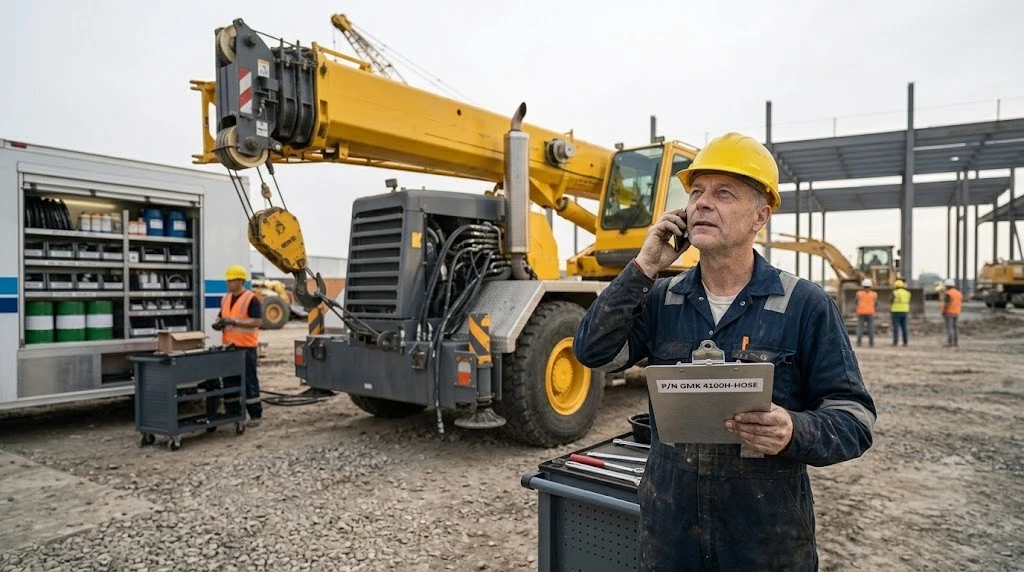
Money leaves your account the moment you confirm an order. Getting that decision right the first time saves you from return shipping costs, restocking fees, and the frustration of waiting for a replacement while your crane continues to sit. The problem is that most operators do not have a structured approach to evaluating who they buy from.
They rely on gut feeling, website appearance, or whoever answers the phone fastest. Those shortcuts work occasionally, but they fail often enough to cause real financial damage over time. A disciplined pre-purchase protocol changes that dynamic entirely.
What follows is a sequence of questions and preparation steps designed to protect your budget and your schedule. Work through them methodically before committing money to any transaction.
1. Identify Whether You Are Getting OEM or Aftermarket
This is foundational because everything else depends on knowing what you are actually purchasing.
OEM parts originate from the original equipment manufacturer or a factory operating under their direct authority. The part matches every physical and performance specification of the piece it replaces. Steel grades, electrical ratings, dimensional tolerances — everything aligns because the part was designed as an exact duplicate of the factory original.
Aftermarket components come from independent companies. Quality among them ranges from excellent to dangerous. Leading aftermarket producers employ dedicated engineering teams, invest in material testing, and maintain certifications that demonstrate their commitment to performance standards. At the other extreme, fly-by-night operations ship parts made from bargain-grade materials with minimal quality oversight.
A knowledgeable crane parts supplier will disclose the origin of every component on request. Ask them to document OEM or aftermarket status on the invoice. If the item is aftermarket, request the producing manufacturer’s name and product line. Any reluctance to share this information should prompt you to take your business elsewhere.
2. Obtain Committed Delivery Dates, Not Estimates
The difference between a firm date and a vague estimate can represent several days of additional downtime.
Push the seller to confirm two specific pieces of information: the exact date the item will leave their facility and the projected arrival date at your location. Ask whether the component is currently in stock at their warehouse or needs to be sourced from a factory or third-party distribution point.
Both shipping method and point of origin determine your actual delivery window. Standard ground transportation from a facility several states away could consume a full business week or more. Premium next-day air service might get the part to you by tomorrow morning. Calculate the premium against your hourly downtime cost before deciding.
Understanding their daily order processing deadline is equally valuable. Orders placed after a certain hour may not ship until the following business day. These operational details might seem minor, but they compound into real delays when equipment is sitting motionless on your site.
3. Study the Fine Print on Warranties and Returns
Protection after the sale is just as important as the part itself.
Warranty duration varies across the industry. Some providers cover mechanical parts for six months. Others extend that window to a full year. More critical than the timeframe, however, is the coverage boundary. Does the warranty apply only to the replacement component, or does it also compensate for the labor required to remove the faulty part and install the new one? On heavy cranes, that labor cost can be staggering.
Returns carry their own complexities. If you order a component and discover it does not match your specific model, what is the process for sending it back? Is there a restocking fee attached, and at what percentage? Who bears the responsibility for return freight charges? A fifteen or twenty percent restocking penalty on a high-value hydraulic component represents hundreds of dollars you will not recover.
Require documentation of all warranty and return terms before you finalize any purchase. Written terms protect both parties and eliminate the ambiguity that causes disputes later.
4. Seek Out Credible References From Other Operators
A company’s reputation among its existing customers reveals more than any sales presentation ever will.
Ask whether they currently supply other crane operators in your geographic area. Request the names and contact details of clients willing to discuss their experience. A company with a genuine track record of satisfied customers will provide this information readily.
An unwillingness to share references warrants serious concern. It frequently signals either a newcomer without enough operating history to reference or a firm that has accumulated a pattern of customer complaints it prefers to keep quiet.
Conduct your own parallel research by reaching out to operators in your professional network. Ask who they rely on for Grove crane parts when a machine needs attention. Peer recommendations grounded in firsthand experience carry far more weight than any self-generated marketing material. Within the heavy equipment community, a poor reputation circulates quickly and openly among those who matter most.
5. Verify That Meaningful Support Continues After the Sale
Securing the right component is necessary but insufficient. Proper installation and ongoing function complete the job.
Ask whether the company provides any form of post-sale technical guidance. If the electrical connector on your replacement module does not match your existing wiring, can you reach someone who understands the system? If a newly fitted sensor continuously triggers error codes, is there a technician available to help you diagnose the issue remotely?
A generalist parts counter sells you a product and moves on. A provider with deep equipment knowledge understands how the parts they distribute interact with the mechanical and electrical systems on your machine. They help you determine whether a problem stems from a defective component, an installation issue, or an incompatibility with another part of the system. That diagnostic assistance saves both time and unnecessary expense.
This caliber of support distinguishes a genuine resource from a mere transaction point.
6. Organize All Machine Specifications Before You Dial
Preparation before the call prevents the most costly and time-consuming ordering errors.
Before contacting any seller, compile three essentials: your crane’s serial number, the model designation of the failed component, and — if the old part remains accessible — any identification numbers stamped or cast into its physical surface. Equipment manuals, data plates, and maintenance logs are all valuable sources for this information.
Manufacturers periodically revise components during a model’s production run. A boom hoist motor used in a 2010 crane may differ internally from the version installed in a 2013 model, even though both appear virtually identical externally. Gear specifications, seal compositions, and electrical connector layouts can shift between production years without any visible cue.
When the conversation begins, lead with the serial number. Confirm the model year. Read the part number at a measured pace, digit by digit. Before ending the call, ask the representative to repeat every detail back. A single transposed number can result in receiving the wrong component and enduring another full delivery cycle.
7. Read the Signals in Their Communication Style
How a company interacts with you during the sales process reveals volumes about how they will behave afterward.
When you request a quote, observe the response time. During normal business hours, does a live person answer your call, or does every attempt route through an automated system? If you leave a message, how quickly does a return call materialize?
A seller that is difficult to reach while competing for your order will almost certainly be less responsive once your payment has cleared. You need a team that answers calls, addresses written inquiries without excessive delay, and proactively provides order status updates rather than forcing you to initiate every check-in.
Consistent, transparent communication forms the backbone of a productive relationship. When you trust that your questions will receive timely answers, you stop second-guessing every transaction and focus your energy on keeping your fleet operational.
8. Start Building the Relationship While Things Are Calm
Searching for a new parts source during an active equipment crisis is one of the worst decisions an operator can make. Stress compresses your thinking and pushes you toward shortcuts.
Begin building these relationships during periods of stability. Contact several companies, pose these questions, and evaluate the quality of their answers. Place small trial orders for routine service items — filters, hydraulic fluid, basic seals — and assess how smoothly the process runs from order placement through delivery.
If your operation involves multiple machines, you need a dependable crane parts supplier that understands the demands of fleet-level maintenance. You want trained professionals who can identify a component from a brief description, confirm compatibility, and process a shipment the same day you call.
Once you find a partner that earns your confidence, share your fleet inventory and maintenance calendar. Communicate your ordering patterns and seasonal needs. A strong supplier uses that information to monitor your purchase history, warn you about factory supply disruptions, and proactively recommend service components before your stock runs out. Over time, they function as a genuine extension of your maintenance planning operation.
Closing Perspective
Parts purchasing for heavy equipment is a recurring expense that directly impacts your bottom line and your project timelines. Every decision in this process deserves careful consideration.
Do not settle for whichever option appears first. Verify the authenticity and manufacturing grade of every part. Secure confirmed delivery dates in writing. Examine warranty coverage and return provisions with precision. Request references you can independently contact. Ensure that knowledgeable technical assistance remains accessible after the sale concludes.
When you locate a company that answers each of these questions with honesty and expertise, you have found a reliable partner for Grove crane parts who will help you minimize downtime, protect your equipment investment, and maintain the confidence that comes from making well-informed purchasing decisions every time.
Comments
No comments yet. Be the first to react!