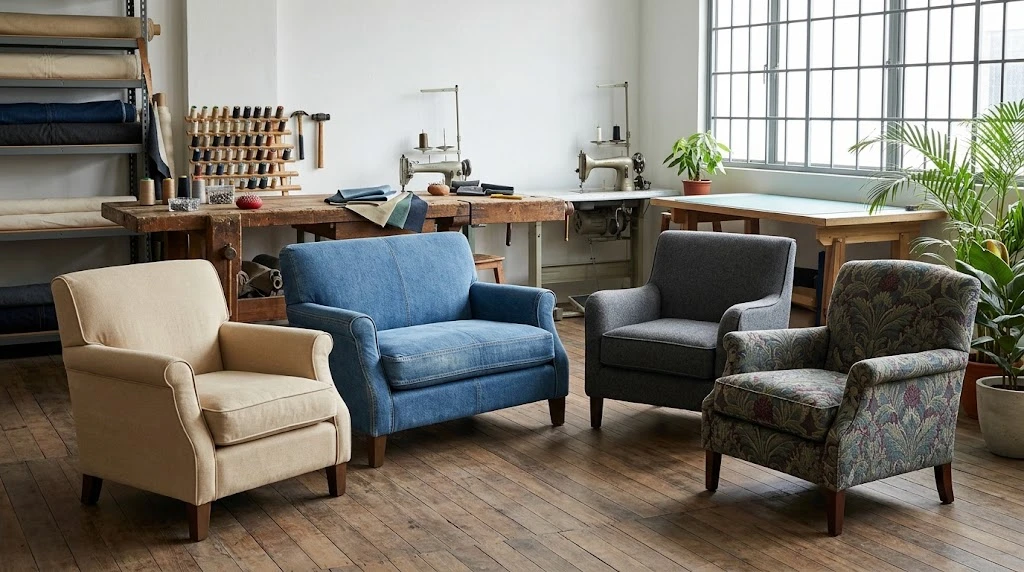
When it comes to re-covering a sofa, most people reach for familiar territory. Leather, linen, polyester blends — these are the defaults everyone knows. But default doesn’t mean best, particularly for furniture that sees constant daily use. Some of the most practical sofa solutions come from textiles most homeowners never think to consider.
Canvas, denim, wool, and tapestry are everyday materials with proven track records in demanding applications. They show up more often in wardrobes and workshops than in living rooms, but that’s starting to change. Before committing to a sofa reupholstery project, it’s worth understanding what these unconventional options actually offer — and what working with them involves in practice.
Canvas: Quietly Tough and Underrated
Canvas is a heavy, plain-woven fabric, typically cotton or a cotton-poly blend. You’ll find this same textile in tents, work aprons, and heavy-duty tote bags. Those demanding applications hint at exactly why it works on furniture: it’s engineered to take punishment.
Durability is the standout quality here. A tightly woven canvas rated for heavy use endures years of daily sitting, pets sprawling across cushions, and kids treating the arms like climbing walls. It resists snagging and holds its shape remarkably well over time. Professionals who offer sofa upholstery services often note that canvas is one of the few materials that actually improves visually as it softens with age.
The trade-off is stiffness. Fresh canvas has almost no flexibility, making it challenging to fit around curves and tight corners. An experienced upholsterer addresses this through steaming, careful easing, and sometimes pre-washing to relax the fibers before cutting. For someone attempting their first DIY project, canvas isn’t ideal — but for a sofa reupholstery handled by a skilled professional, it’s a genuinely smart pick.
Canvas reads as casual and approachable in a room. It suits farmhouse, industrial, and coastal interiors far better than formal spaces. Modern options come in a wide color spectrum and accept dye readily, so you’re not locked into that painter’s-drop-cloth beige. It also pairs naturally with slipcovered styles where a relaxed, slightly rumpled look is the whole point.
One practical advantage worth noting: canvas is generally affordable. Designer upholstery fabrics can reach steep per-yard prices, while canvas typically costs a fraction. On a large sofa requiring 15 to 20 yards, the savings add up quickly.
Denim: Familiar Comfort Scaled Up
Here’s something worth remembering — you already know how denim behaves. You’ve owned jeans that softened, faded, and developed personality over years of wear. On a sofa, denim does exactly the same thing.
As a cotton twill with a diagonal weave, denim combines genuine strength with immediate softness. It’s more pliable than canvas from the start, so it drapes around frames with less effort. Against bare skin, it’s comfortable enough for lounging — a real consideration if your sofa is the household’s primary relaxation zone.
The visual appeal is straightforward. A mid-blue denim sofa in a family room looks intentional and welcoming. Because denim fades gradually and unevenly, it develops a rich patina over time, somewhat like leather aging but in woven form.
The drawbacks are manageable but worth knowing. Direct sunlight causes noticeable fading, sometimes surprisingly fast. If your sofa faces a bright window, expect visible changes within a couple of years unless you rotate cushions or use window film. Denim also stretches slightly with use, so those experienced with sofa upholstery services in Singapore will pull it tight during installation to prevent sagging later.
One crucial tip: select upholstery-weight denim rather than fashion denim. Upholstery-grade denim is heavier, more dimensionally stable, and built for furniture demands. Fashion denim from garment fabric stores is typically too thin to withstand the demands of sofa use.
Maintenance is simple. Spot cleaning works well, and gentle wear tends to look natural rather than neglected — as long as the structure underneath remains solid.
Wool: The Natural Fiber Worth Reconsidering
Wool doesn’t come up often in upholstery discussions, which is surprising given its properties. Lanolin in the fibers provides natural stain resistance. It’s inherently flame-retardant without chemical additives. It also regulates temperature effectively, avoiding the clammy feel some synthetics produce in warm weather.
The texture of wool upholstery is distinctive and hard to replicate. A wool-covered sofa has a warmth and substance that flat-weave cotton simply can’t deliver. In modern interiors, wool works especially well with minimalist and Scandinavian-leaning spaces — its subtle surface texture adds interest without relying on pattern or bold color.
Cost is the primary consideration. Quality wool upholstery fabric is often the most expensive option on this list. Yet wool fibers are remarkably resilient, bouncing back from compression so cushions keep their shape instead of developing that crushed, tired appearance. Homeowners who invest in wool during a sofa reupholstery often view it as a long-term decision, since the fabric commonly outlasts multiple cycles of standard polyester.
Wool does require some attention. Pilling can appear in high-friction areas early on, though it usually subsides once loose fibers work free. Scrubbing should be avoided — blot stains instead. While wool handles ambient humidity well, sustained dampness poses real problems.
Wool blends offer a sensible middle ground. A wool-nylon combination preserves the texture and resilience while reducing cost and improving abrasion performance.
Tapestry: Visual Richness No Plain Fabric Can Match
Tapestry is the wildcard on this list. Woven pictorial fabrics — the kind traditionally seen hanging on walls or covering antique chairs — bring pattern, color, and historical depth to a sofa in ways no solid textile can approach.
The visual impact is immediate. A tapestry-upholstered sofa commands attention as the focal point of any room. Florals, botanical illustrations, geometric folk patterns, and scenic designs carry real dimension because the imagery is woven in, not printed on top. Vintage tapestry yardage, sometimes salvaged from old curtains or wall hangings, adds extra character and keeps usable material out of landfills.
Durability varies enormously, and honesty is essential here. Heavy upholstery-grade tapestry performs well, but lightweight decorative versions wear through seat cushions within just a few years. The smartest strategy is selective placement: tapestry on the sofa back and sides where wear is minimal, paired with a solid, sturdy fabric on seats and arms. Reputable sofa upholstery services employ this technique frequently for antique and statement pieces, and it also stretches expensive or limited fabric further.
Installation requires particular skill. Pattern matching is critical — a misaligned seam across a cushion looks jarring immediately. Aligning woven pictorial designs around a sofa’s curves demands real expertise, and this is one reason tapestry projects often require additional labor hours.
Care mirrors wool maintenance, since many tapestries are wool-based. Vacuum gently with an upholstery attachment, blot spills right away, and keep the piece out of harsh direct sunlight.
Practical Ground Rules for Any Unconventional Fabric
Whatever direction appeals to you, several principles hold across all these options:
Check the double rub count. This measurement indicates abrasion resistance. For daily sofa use, target at least 25,000 double rubs — 15,000 minimum for a piece that sees only light duty. Canvas, heavy denim, and upholstery-grade wool and tapestry generally clear these thresholds. Fashion-weight materials often fall short.
Order physical samples first. Colors look different on a monitor. Textures feel different in your hand. Live with a swatch in your space for a week before committing to yardage for an entire sofa.
Consult your upholsterer early. A professional can tell you whether the material you love suits your specific frame, estimate yardage accurately, and flag technique adjustments that might affect the scope. Non-standard fabrics sometimes require specialized handling, which influences both process and cost.
Think about the room holistically. A denim sofa, a wool sofa, and a tapestry sofa each generate entirely different moods. Fabric choice isn’t just practical — it anchors the visual tone of everything around it.
Choosing Something Unexpected — On Purpose
Unconventional doesn’t mean risky. Canvas, denim, wool, and tapestry are established textiles with long histories in demanding roles — just not always on sofas. Each brings something standard options lack: canvas offers toughness at modest cost, denim provides comfort that deepens with age, wool delivers natural performance and impressive longevity, and tapestry supplies visual richness no other material can replicate.
When you’re weighing a sofa reupholstery, the fabric is arguably the single biggest decision in the entire project. Structural work and craftsmanship matter tremendously, but the fabric is what you see, touch, and live with every day. Choosing something unexpected — and choosing it deliberately — is often what separates a sofa that merely functions from one that genuinely earns its place in your home.
Comments
No comments yet. Be the first to react!