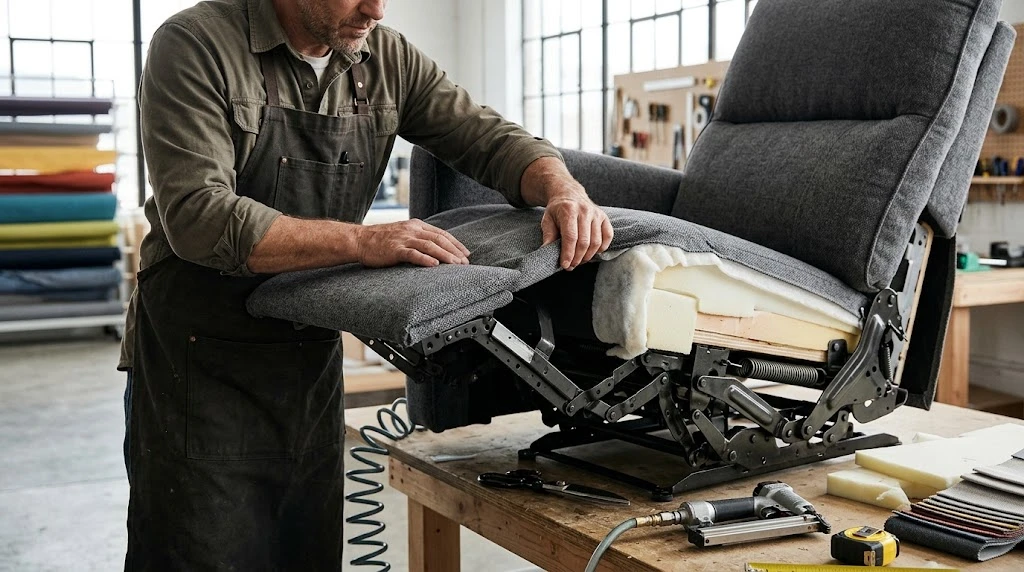
Most upholsterers will tell you that furniture with moving components sits in a category of its own. Recliner sofas are the clearest example. A fixed-frame couch asks little of its fabric beyond staying taut and attractive. A recliner asks the material to stretch, compress, cycle thousands of times, and still maintain a clean silhouette when everything is at rest.
This guide works through the three areas that matter most: the underlying mechanism, the zones where wear concentrates, and the fabrics that survive the demands of motion.
What Makes Recliner Mechanisms So Demanding
Every recliner is built around movement, and that single engineering choice alters the entire upholstery process. Imagine pulling a fitted sheet across a mattress that keeps changing shape — that is roughly what the fabric on a recliner experiences. Too much tension and the seams split when the footrest swings out. Too little and the chair looks rumpled the moment it returns to its upright position.
Inside the frame, a network of steel linkages, springs, and glide tracks does the actual work. These components require clearance. Experienced upholsterers intentionally build extra fabric — known in the trade as “ease” — around every pivot point. Welt cord reinforcement and boxed-corner construction further reduce the risk of stitching failure at high-tension intersections.
The removal of hardware is non-negotiable. Anyone performing sofa upholstery services on a recliner must unbolt the seat assemblies, detach the release cables, and recover individual panels on the bench. Trying to staple new fabric around a mounted mechanism is a shortcut that leads to visible wrinkles, restricted movement, or both. Each component should be handled as its own project within the larger job.
Electric recliners add wiring to the equation. The fabric path must avoid every motor and cable run. A single misplaced staple that pierces a power lead can disable the chair entirely. Clearance around the motor housing is equally important — if the fabric presses against the actuator during travel, the motor strains, draws excess current, and fails prematurely.
Where Wear Concentrates and Why
Pattern recognition makes a huge difference in recliner work. Failure almost never happens in random spots. The same four areas account for the vast majority of damage.
Footrests take the heaviest beating. Metal edges grind against the fabric every time someone reclines and sits back up. The front lip of the footrest absorbs this abuse directly. Reinforcing it with a doubled layer of material and double-stitched seams extends its life considerably. Some technicians also bond a strip of thin protective fabric to the hidden side, creating a sacrificial surface that bears the brunt of the friction.
Headrests fail through chemistry rather than mechanics. Scalp oils and sweat penetrate textile fibers and break down the sizing and dyes. The result is a stubborn dark band across the top of the chair that no amount of cleaning eliminates. Sunlight makes matters worse by degrading fibers through UV exposure. When the recliner sits in a bright room, choosing a UV-resistant fabric for the headrest area is a practical decision, not an optional one.
Armrests suffer from body weight leverage. When someone pushes up out of a recliner, significant force concentrates on the arm pads. The foam compresses, the fabric stretches, and the arm develops a permanently sunken look. Operators of sofa upholstery services who skip foam inspection during the tear-down phase almost always get a call back within a few months. Batting wraps can restore slight losses in loft, but flattened foam offers no substitute for replacement.
Seat seams endure the most combined stress of any joint on the furniture. This is where the seat back panel meets the seat platform, and it flexes with every cycle of the mechanism. Thread choice here is critical. Cotton thread breaks down under repeated pulling and humidity, leading to seam separation. Bonded nylon resists both forces and remains strong through years of daily use.
Matching Fabric to the Job
A recliner’s fabric must satisfy three requirements simultaneously. It has to resist abrasion, tolerate repeated flexing, and recover its shape between cycles. The Martindale and Wyzenbeek abrasion tests provide a quantitative basis for comparison. For recliner upholstery, the general guideline is a minimum of 30,000 rubs before the surface begins to thin.
Leather has its advocates, and for good reason — it is durable, simple to clean, and ages with character. The caveat is flexibility. Rigid top-grain hides tend to crack along fold lines where the mechanism moves. Bonded leather performs poorly under any amount of cycling; its laminated surface separates and flakes, often within a year. If leather is the chosen route, it should feel soft and supple. Sewing leather also demands specialized needles to avoid perforating the hide in the wrong places.
Synthetic performance fabrics are widely considered the strongest choice for recliners. Olefin and polyester blends combine stain resistance with inherent stretch. That elasticity allows panels to follow the mechanism without stressing seams. Compared with natural fibers, these materials also resist fading from light exposure over much longer periods.
Microfiber is another strong candidate. The tight weave structure gives pet claws nothing to grip, so the surface stays free of pulls and snags. The fabric offers enough mechanical give to accommodate a moving frame. It also forgives minor cutting errors, which is a relief during complex pattern work.
Materials worth steering clear of include heavyweight canvas and stiff linen. Both lack the stretch a recliner demands, so the moment the footrest extends, rigid fabric hammers against the staples until something gives. Velvet, while attractive, loses its nap quickly on the footrest lip and other contact surfaces. Silk snags on the first movement and offers no compensating durability.
The Role of Foam and Padding
Surface fabric is only half the equation in sofa reupholstery. What lies underneath determines whether the finished piece feels right or still sags. Recliners built more than a few years ago almost always have degraded foam by the time they reach the workshop.
Polyurethane foam loses density with age and compression cycles. Placing fresh fabric over old, collapsed foam produces a piece that photographs well but disappoints in daily use. High-resilience foam restores the original comfort profile and maintains its loft far longer than standard grades. For recliners, a density rating of 2.5 to 3.0 pounds per cubic foot is a proven specification.
A Dacron polyester wrap serves two purposes. It rounds out cushion edges for a more finished look, and it separates the fabric from the foam surface. That separation matters because foam — especially open-cell polyurethane — acts like fine sandpaper against the inside of a cushion covering. Over time, that internal abrasion wears through fabric that never sees a single moment of visible contact.
Beneath the foam, springs and webbing carry the structural load. Sagging in a recliner often traces back to stretched sinuous springs rather than worn-out foam. While the frame is apart, replacing tired springs costs a fraction of what the same repair demands once the piece is fully reassembled.
Weighing the DIY Route Against Professional Help
Can a dedicated hobbyist reupholster a recliner at home? The short answer is yes — with significant caveats. Sewing multiple layers of heavy upholstery fabric requires a machine with real power. Most domestic models simply cannot push a needle through the material without skipping stitches or stalling.
The alignment requirement is where most amateur projects go wrong. Every panel must fit correctly in two positions simultaneously: fully upright and fully reclined. Cut too short, and the mechanism strains against the fabric on every cycle. On electric models, that resistance can overheat the motor. Cut too long, and the excess material bunches unattractively during normal seating. Adjusting either error after attachment is tedious and often imperfect.
Frame disassembly presents its own difficulties. Hidden fasteners, tight wire channels, and spring clips all need to come apart in the right order. Tooling matters too. A pneumatic stapler drives fasteners flush into hardwood frames with minimal effort. Hand-stapling a recliner frame for an entire afternoon is a test of endurance, and the results rarely match.
Because of these factors, a large number of furniture owners engage professional sofa upholstery services in Singapore rather than attempt the work themselves. A trained technician understands exactly how much slack to leave at each joint and operates industrial equipment that handles layered seams without hesitation. For households looking to extend the life of a well-built recliner, professional sofa reupholstery is often the more sensible route, particularly when electric mechanisms are involved.
Vetting a tradesperson requires asking targeted questions. Recliner experience specifically matters — an artisan who specializes in antique dining chairs may never have routed fabric around a motor. Ask how they reinforce the footrest edge, what thread grade they use on load-bearing seams, and how they verify clearance around moving components before final assembly.
Wrapping Up
Recliners are mechanically complex pieces of furniture, and the upholstery must cooperate with that complexity rather than fight it. Failure concentrates in predictable areas — the footrest lip, the headrest, the arm pads, and the seat seam — and each one demands specific countermeasures. Fabric selection matters as much as technique; a material rated for heavy commercial use and flexible enough to follow the mechanism will outperform a stiffer, more decorative alternative every time.
Internal components deserve equal attention, since new fabric over old foam and tired springs produces a result that looks better than it feels. Whether the project happens in a home garage or on a professional bench, patient measurement, disciplined seam reinforcement, and a full mechanical test before reassembly determine whether the finished recliner performs for years or disappoints within months.
Comments
No comments yet. Be the first to react!